Technical Guide
BAC Series 1500 fill replacement: module sizing
2026-11-09 · Engineering
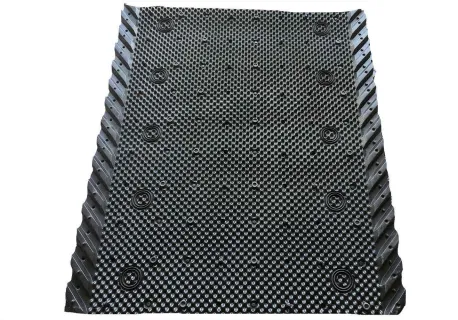
A Series 1500 crossflow unit that has run 8–12 years is usually still structurally sound; it is the pack that has gone. The job is decided by one thing: whether the replacement modules match the bay actually in front of the crew. Two Series 1500 towers on the same site can take different module counts if one was re-decked or re-louvered. Sizing is a four-measurement job, and getting it right is the difference between a weekend swap and three weeks of site fabrication.
1. Measure four dimensions, in this order
- Air-path depth. The distance air crosses through falling water — 610, 915 and 1220 mm cover most crossflow bays. Measure between the louver face and the drift eliminator plane, not the tray lips; lips add 25–40 mm the module cannot use.
- Usable face height. Basin curb to the underside of the distribution headers, minus 100–150 mm for spray-header clearance.
- Module length. The horizontal run, usually a multiple of 300 mm: 1220, 1520, 1830 or 2440 mm.
- The support grid. Beam pitch, depth and condition. Photograph it before the old pack comes out; it most often forces a redesign after the order is placed.
2. The depth figure is the one that gets copied wrong
In a crossflow tower, depth is the flute run along the airflow; face height is the vertical dimension. Face height is the visible one, so it lands in the inquiry email, and the error costs in both directions: a 915 mm pack will not fit a 610 mm bay, and 610 mm in a 915 mm bay throws away 0.4–0.8 °C of approach at design wet-bulb before the fan is re-checked. Where bay depth is fixed and duty is not negotiable, the honest lever is flute spacing: a 16 mm flute pack carries 15–25% more surface area per cubic metre than 20 mm at identical depth, and costs 15–25% more pressure drop. Worth taking when static headroom exists, worthless when it does not.
3. Turning measurements into a module count
| Parameter | Typical values | What it fixes |
|---|---|---|
| Air-path depth | 610 / 915 / 1220 mm | Module depth — single choice |
| Module face height | 915 / 1220 / 1525 mm | Row count: face height ÷ module height |
| Module length | 1220 / 1830 / 2440 mm | Blocks per row, plus a cut filler strip |
| Flute spacing | 16 / 19 / 20 mm | Surface area 150–220 m²/m³ vs pressure drop |
| Sheet thickness | 0.35 / 0.45 mm | Weight, support span, service life |
Worked example, bay assumed at 3.05 m face height, 6.10 m length, 610 mm depth: at 1525 mm module height that is two rows; at 1830 mm module length, three modules plus a 610 mm strip — six modules and a filler per bay. Volume is 3.05 × 6.10 × 0.61 = 11.35 m³ per bay, 22.7 m³ for the pair. Each 1525 × 1830 module weighs roughly 127 kg dry, which two people can hand through a louver opening without a crane; a 2440 mm block of the same sheet needs rigging and a longer shutdown.
4. Grid limits, weights and RFQ lines
Dry density runs 110–135 kg/m³ at 0.45 mm sheet and 95–115 kg/m³ at 0.35 mm, with wet weight a further 10–14% above dry. Support pitch follows sheet thickness: 900–1220 mm is normal for 0.45 mm, and wider than 1220 mm invites sagging and channel distortion within two seasons. If the retained grid was built for a thinner pack at coarser pitch, the honest options are a new sub-grid or a lighter module, not a promise that old beams will hold. Standard glue-free modules in 610 and 810 mm depths drop into most retained trays without touching the structure.
Six lines save a week of correspondence: bay depth, usable face height, module length, support pitch, water loading, and design wet-bulb with entering and leaving water temperatures. Quote the tower model only as a cross-check — it tells a supplier which family to price, not which module to cut. 2026 ranges, FOB China: glue-free crossflow modules 610–915 mm at USD 105–150 per m³; heavy-duty 1000–1520 mm at USD 95–135 per m³; 16 mm precision flute at a 5–12% premium; new support steel adding 20–35% when the existing grid cannot be reused.
Conclusion
Replacing fill in a Series 1500 tower is not a parts-catalogue exercise. Measure air-path depth and usable face height first, let those two numbers pick the module, then check grid and fan against the result. A bay that takes a deep 1000–1520 mm heavy-duty module should have one; a bay built around a 610 mm tray should not be forced into it.
Send the four measurements, the support pitch and two seasons of approach readings, and our engineers will return a module schedule — block count, orientation, weight per block, support pitch and cost per m³ — stated line by line.