Technical Guide
Cleaning cooling tower fill: methods, frequency and limits
2026-11-13 · Engineering
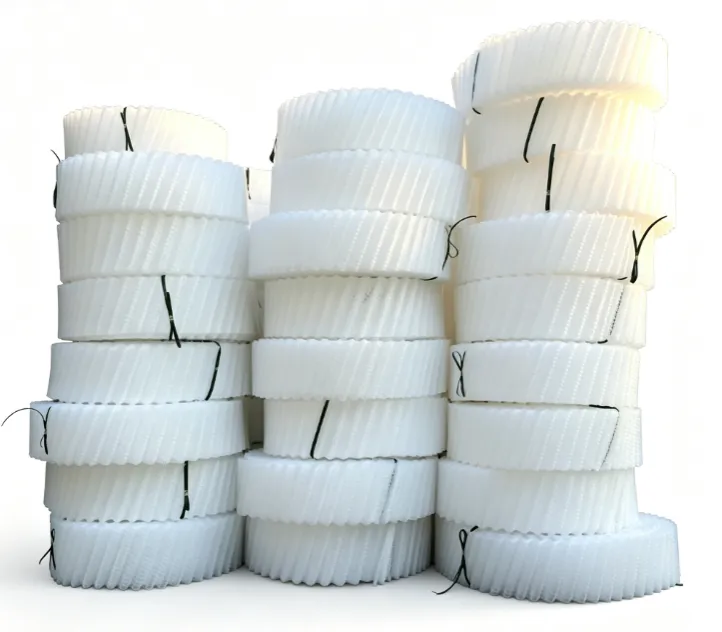
A fouled pack announces itself as lost approach — 1–2 °C after two or three seasons. The reflex is a pressure washer at whatever pressure the site machine delivers, and that is the quickest way to turn a cleanable pack into a purchase order: a 0.35 mm PVC sheet deforms permanently under a fan jet at 12 bar held 200 mm away.
Cleaning is a chemistry and pressure problem, not a labour problem, and side-by-side towers can need opposite treatments. Here is what works on each deposit, how often it is needed, and four things that should never touch the fill.
1. Identify the deposit before choosing a method
Scale wants acid, biofilm wants alkali and biocide, iron oxide wants a chelant, silt wants water and nothing else. Sample from three positions — top face, mid-height, flute root — because the top face is the least informative.
| Deposit | Method | Working numbers | What goes wrong |
|---|---|---|---|
| Silt, mud, leaves | High-volume, low-pressure wash | 3–5 bar, 30–50 L/min, 200 mm standoff | Low flow only packs debris into the flute root |
| Calcium carbonate scale | Inhibited sulfamic acid | 2–4% w/w, pH 2–3, 45–90 min, below 40 °C | Uninhibited acid attacks the PVC stabiliser |
| Biofilm, algae | Alkaline wash, then biocide | pH 9–10, 2–4 h soak, free chlorine 2 ppm max continuous | Chlorine shock above 5 ppm embrittles edges |
| Iron oxide, manganese | Chelant (citrate or EDTA) | pH 4–5, 2–4 h, 30–40 °C | Dried chelant forms a hard film in the flutes |
| Oil and grease | Alkaline degreaser, then rinse | 1–2% surfactant, 60 °C, 30 min contact | Residual oil re-collects dust within weeks |
Dwell time matters more than strength; doubling acid strength to halve the soak etches flutes. Tight spacing holds deposits harder — a 16 mm flute pack needs the low-pressure, high-volume end of that range, while a 750 mm retrofit pack with wider flutes clears in about two-thirds the time per m³.
2. Pressure, temperature and the limits of the sheet
- Pressure. Stay below 8 bar and 150 mm off the sheet. Above 10–12 bar at close range, flute tips fold and the bond line lifts.
- Temperature. PVC softens near 60 °C and loses stiffness from about 50 °C. Wash with water between 20 and 45 °C.
- Thermal shock. Never run 10 °C mains water into a pack still at 55 °C; cool the tower for two hours or a 45 K step cracks edges at the glue line.
- Never steam. Steam warps a pack permanently.
3. Frequency is set by makeup water, not by the calendar
An annual clean is correct on one site and four times too slow on another. Start from the water source and cycles of concentration, then override on measurement: clean when pressure drop across the fill rises 25–30% above commissioning, or approach drifts 1.0–1.5 K at the same wet-bulb and flow.
| Makeup source | Typical deposit | Interval |
|---|---|---|
| Municipal supply, 3–4 cycles | Light scale, some biofilm | 12–18 months |
| Borehole water, hardness above 250 mg/L as CaCO₃ | Heavy carbonate scale | 6–9 months |
| River or pond water, turbidity above 20 NTU | Silt plus biofilm | 4–6 months |
| Steel mill process water | Oil, mill scale, iron oxide | 3–4 months |
| Filtered closed loop, side-stream filtration | Minimal | 24 months, inspection only |
Budget the labour honestly: contract cleaning runs 0.4–0.6 man-hours per m³, at USD 8–15 per m³ all-in, against USD 95–150 per m³ for a replacement pack. A cleanable spray nozzle set with 3–4 mm orifices keeps debris out of the flutes instead of pushing it down into them.
4. What never to use, and how to prove the clean worked
Four methods that damage fill faster than fouling does:
- Wire brushes and abrasive pads. They score the sheet and give biofilm a key to grip.
- Caustic soda above 5%. It dulls the sheet and does nothing to scale.
- Solvent degreasers — kerosene, diesel, toluene. PVC swells, softens and loses stiffness permanently.
- Neat sodium hypochlorite. Dose the basin, never the pack.
Then verify before the tower returns to service: pressure drop within 10% of the commissioning record, approach recovered by 0.5–1.2 K, dry weight within 5% of a new block (28–34 kg/m³ for 0.35 mm cross-fluted sheet), and 90% of flutes passing light against a lamp. If pressure drop improves but approach does not, the problem was water distribution or airflow, not fouling.
Conclusion
Fill is cleaned by matching chemistry to deposit, keeping pressure under 8 bar and water under 45 °C, and setting the interval from makeup water and measured pressure drop rather than from a calendar. Done that way, a 0.35 mm pack gives 8–12 years; done with a fan jet and neat bleach, it gives three.
Send the makeup water analysis, cycles of concentration and your last commissioning pressure drop; we will return a cleaning method, an interval and a pack specification if the fill is past saving.