Technical Guide
Cooling tower fill depth: 610 vs 810 vs 1220 mm
2026-11-08 · Engineering
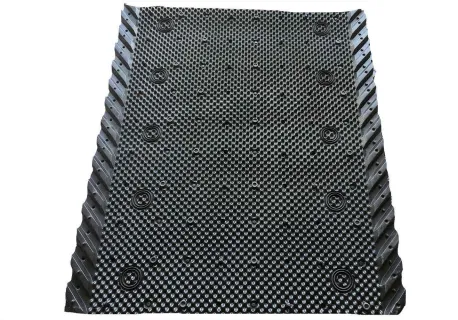
Most crossflow towers lose more thermal headroom to an undersized fill depth than to bad water quality. The pack is the cheapest place in the cooling circuit to buy performance, and the easiest place to buy too little: a 610 mm module chosen for light HVAC duty gets copied onto a process tower running at 3.5 m³/(m²·min), and the operator pays for it for a decade in fan power and a 2 °C approach penalty. Depth, pressure drop and cost move together.
1. What “fill height” actually measures
In a crossflow tower the air crosses the falling water horizontally, so fill height is the depth of the pack in the direction of airflow — 610, 810, 915 or 1220 mm of flute run — while the vertical face is set by module length and tower height. A 1220 mm pack is not twice as tall; it is twice as deep, which doubles the wetted path each air parcel sees and roughly doubles the resistance it meets. Confusing the two directions is the first error in a retrofit survey.
2. Pressure drop scales with depth, not with footprint
At a face velocity of 2.5 m/s, a clean cross-fluted pack at 19 mm spacing and about 200 m²/m³ sits near 20 Pa per 300 mm of depth; a tighter 16 mm geometry adds 15–25% at identical depth because open area falls. Double the depth and resistance doubles almost exactly. Fan power tracks total tower static, and fill is commonly 40–55% of it.
| Fill depth | Surface area (19 mm flute) | Pressure drop at 2.5 m/s, clean | Fill share of tower static |
|---|---|---|---|
| 610 mm | 200 m²/m³ | 18–25 Pa | 33–40% |
| 810 mm | 200 m²/m³ | 26–35 Pa | 42–48% |
| 915 mm | 200 m²/m³ | 30–40 Pa | 45–52% |
| 1220 mm | 200 m²/m³ | 40–55 Pa | 52–60% |
Read the last column as a budget: moving a 610 mm duty to 1220 mm on an existing fan adds roughly 25 Pa of static, and the fan has to be re-checked before anyone promises an approach improvement.
3. What the extra depth buys
Deeper fill works on the water side. Each 300 mm of depth adds contact time and surface area per square metre of plan, pulling approach down at essentially constant airflow. Going from 610 to 1220 mm typically recovers 0.6–1.2 °C of approach at design wet-bulb — provided water loading stays under about 3.0 m³/(m²·min) and the nozzles cover the top face. Above that loading the water films merge, the flute channels flood, and the last 600 mm stops transferring heat and adds nothing but pressure drop. Diminishing returns also arrive early on a short face: at 2.2 m height a 1220 mm pack is a deep, thin slice of media, and air will short-circuit around it unless the louvers seal to the pack edge.
4. Weight, price and choosing a depth by duty
Depth is cheap thermally and expensive structurally. A 1220 mm pack on 0.45 mm sheet runs 110–135 kg/m³ dry and about 12% heavier wet, so support grid pitch tightens from roughly 1220 mm to 900 mm and beams deepen. Price per cubic metre falls slightly with depth — fewer joints, fewer end profiles — while steel, module handling and crane time rise. Workable 2026 ranges, FOB China: 610–810 mm glue-free modules at USD 105–150 per m³, 1000–1520 mm heavy-duty modules at USD 95–135 per m³, support steel adding 20–35% when the existing grid cannot be reused.
- Light HVAC, short face, tight rooftop: 610 mm, accept the approach, keep the 16 mm flute for surface area.
- Standard process duty on a 2.4 m face or taller: 810 or 915 mm — the CF series 610/810 mm glue-free modules drop into an existing tray without touching the structure.
- New build with a 3.0 m face and room for deeper beams: 1220 mm; the heavy-duty 1000–1520 mm range carries the extra span and tighter grid pitch.
- Retrofit where the media must match the tray: measure what is there — the CF915-MA universal replacement infill covers the 915 mm jobs where a deeper pack will not fit.
Conclusion
Fill depth is a system decision disguised as a part number. Start from face height, water loading per square metre and the existing support grid, then check the fan against the new static before promising anything. If the structure carries 1220 mm, take it and bank the 0.6–1.2 °C; if it does not, an 810 or 915 mm pack at the right flute spacing delivers most of the gain at a fraction of the civil work.
Send the tower type, face dimensions, basin depth, water loading and two seasons of approach readings, and our engineers will return a depth recommendation with pressure drop, module count, support pitch and cost per m³ stated line by line.