Technical Guide
Cooling tower fill fouling: diagnose, clean or replace
2026-11-07 · Engineering
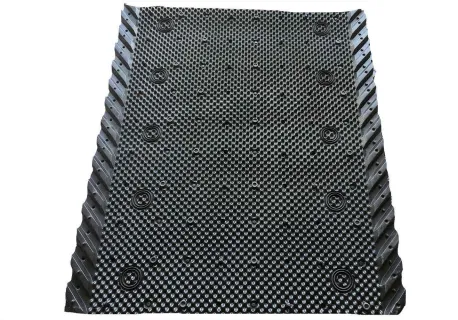
Film fill rarely fails all at once. It fouls. A pack that left the factory with 160 m²/m³ of wetted area can be running at 130 m²/m³ three summers later without a single broken sheet, and nobody notices until the plant is short on approach in July. Three numbers catch it early: approach against the commissioning value, static pressure drop across the pack, and the visible flute gap at the top face.
1. What fouling costs, and how to read it
A layer of 0.2–0.5 mm on the flute walls does two things at once: it narrows the air channel and it insulates the water film from the air stream. A pack that loses 15% of its open area typically shows 30–50% more air-side pressure drop at the same airflow, and fan power tracks pressure drop almost linearly. On the water side, each 1 °C of lost approach is worth roughly 1.5–2.5% of chiller efficiency. The curve is the trap: slow for two seasons, then accelerating.
| Indicator | Clean | Watch | Plan replacement |
|---|---|---|---|
| Approach vs commissioning | 0–0.5 °C | 0.5–1.5 °C | >1.5 °C |
| Static pressure drop | <10% above baseline | 10–25% | >25% |
| Blocked flute area, top face | <5% | 5–15% | >15% |
| Dry mass gain, cut sample | <5% | 5–12% | >12% |
Weigh a 150 × 150 mm sample wet and dry first. Above 12% dry mass gain, no practical wash clears a cross-fluted geometry, where two flutes meet at dozens of contact points per square metre.
2. Identify the deposit before choosing a method
- Scale. Hard, off-white, concentrated where evaporation finishes — the top 150–300 mm of the pack and the flute crests. Cycles of concentration above 5 with make-up hardness over 200 mg/L as CaCO3 produce it, and water alone will not remove it.
- Biofilm and algae. Green-black slime on the distribution deck and the top layer, where sunlight meets 30–35 °C water. Nutrient load and stagnant basins drive it more than temperature does.
- Silt. Grey-brown deposit at the inlet face and the bottom of the pack, tracking suspended solids above roughly 50 mg/L or a failed sidestream filter.
Mixed deposits are normal in industrial service. Drop a dried sample in dilute acid: carbonate fizzes, silt does not.
3. Clean within the limits of the sheet
A large share of damaged fill in the field was destroyed by cleaning, not by the water. PVC softens with temperature and deforms permanently under a jet it survived when new. Keep wash water below 40 °C, hold the nozzle at least 300 mm from the face, keep the jet at 30–45° to the sheet instead of square-on, and cap pressure at 40 bar. A 0.35 mm sheet deforms at pressures a 0.45 mm sheet shrugs off.
For chemistry, use 0.5–1% sodium hypochlorite for biofilm and 2–5% sulfamic or citric acid for scale, then rinse to neutral pH. Never use chlorinated solvents, and never let acid stand in a basin overnight.
4. When a new pack is the cheaper answer
Two conditions settle it: blocked area above 15%, and embrittlement. Bend a strip of sheet 180° — PVC that has lost its plasticiser cracks instead of folding, and a brittle pack sheds pieces into the basin within a season. A pack needing washing more often than every 18 months is finished economically too: field cleaning runs USD 8–15 per m³ with downtime, while a new pack costs USD 95–150 per m³ and resets the clock. Do the arithmetic over five years, not one.
On the replacement, choose the geometry for the water, not the catalogue. A 20 mm flute spacing fouls measurably slower than a 16 mm pattern and is easier to inspect; the CF800 series covers both spacings in one footprint. Counterflow towers foul faster than crossflow at identical water quality, because water runs down the flutes and deposit has nowhere to shed — the VF series counterflow fill widens the effective channel, but the upstream side still has to be fixed.
That upstream side is usually the distribution system. A fouled pack under clean nozzles recovers; a clean pack under a blocked spray header fouls again in one season. Check the LZ anti-clogging nozzle range before the next fill order, and inspect headers after every basin clean-out.
Conclusion
Fouling is a maintenance problem with a measurement solution: baseline the approach and pressure drop at commissioning, inspect the top face twice a year, weigh a sample when the numbers drift, and clean inside the temperature and pressure limits of the sheet. Replace when blockage passes 15%, the sheet is brittle, or the cleaning interval falls under 18 months.
Send your tower model, fill height, flute spacing, water analysis and two seasons of approach readings, and our engineering team will return a written assessment — clean, re-pack or re-geometry — with surface area per cubic metre and support grid pitch stated explicitly.