Technical Guide
Cooling tower fill freeze protection: ice load and design
2026-11-12 · Engineering
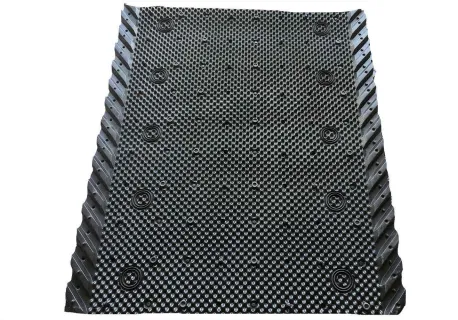
Film fill is the cheapest part of a cooling tower and the first thing winter takes out. It does not need a catastrophic freeze: one night at −6 °C with the fans running and flow cut back for turndown is enough to bridge the air gaps at the fill face, crack 0.35 mm sheet along the flute folds, and load beams sized for wet pack and nothing more. Most of the damage stays invisible until spring, when the tower derates and the fill comes out in pieces.
1. Where the ice forms
Three mechanisms cause almost all winter fill damage, and each needs a different fix.
- Spray-zone icing. Water leaves the nozzles at 20–30 °C into air at −10 °C. Ice grows on the louver and the first 150–200 mm of fill — the part that does the most work per kilogram of sheet.
- Dry-sheet freezing. Below roughly 50% of design flow, sheets de-wet in patches. An unwetted film freezes in minutes, and the next pass of water freezes on top as a lens inside the flute.
- Structural ice. Icicles on fan deck beams load anchors never checked for a 20–60 kg/m pendant; when they let go they puncture the eliminator, not the fill.
2. What ice adds to the load
Ice weighs about 917 kg/m³, so 1 mm over 1 m² is 0.92 kg. A 20 mm rime layer on a 10 × 10 m fill face is 1.8 tonnes, sitting where the pack is already heaviest. Support design in most towers assumes 60–80 kg/m² for 1.2 m of wet fill — the 73 kg/m² (15 psf) figure in most specifications — at 1/300 deflection.
| Component | Normal load | 20 mm ice | Failure mode |
|---|---|---|---|
| Fill, 1.2 m deep, wet | 60–80 kg/m² | +18 kg/m² | Sheet buckling, sag past 1/300 |
| Air inlet louver | 8–12 kg/m² | +18–25 kg/m² | Blade bow, splash-out, ice shedding |
| Drift eliminator | 4–6 kg/m² | +10–15 kg/m² | Blade sag, drift rate climbs |
| Fan deck beams | Icicles | 20–60 kg/m | Anchor cracking, ice falls onto fill |
That ice does not have to break a beam to cost money. It bridges the 6–8 mm gaps between sheets, air-side pressure drop rises 20–40%, and the fan pays the difference while approach drifts up 1–2 °C.
3. Keep the sheets wet
Freezing is a flow problem before it is a fill problem.
- Minimum flow. Hold at least 60% of design flow in any cell running below −5 °C; under 50% the pack de-wets and damage starts within hours.
- Leaving water. Keep cold water above about 10 °C by bypassing part of the load, not by throttling the whole tower.
- Fans. Cycle on leaving water temperature, and stop fans in any cell carrying under 40% flow.
- Basin heat. 20–40 W/m² of basin surface keeps the sump above 4 °C; that is cheaper than one frozen riser.
4. Winter-ready fill and inspection
Four specification changes matter. Use 0.45 mm sheet rather than 0.35 mm: the heavier gauge survives a freeze-thaw cycle that cracks thin film along the fold. Take 20 mm flute spacing over 16 mm where duty allows, because the wider gap sheds ice instead of bridging it. Specify glue-free blocks so a damaged module swaps without dismantling the bay — CF series cross-fluted fill in 610 and 810 mm depths assembles flat in the bay with no adhesive cure. And pair counterflow fill with an M- or S-type air inlet louver to cut the recirculation that feeds ice on the louver face.
Keep PVC below 50–55 °C hot water; above that the sheet softens, and a frozen block will not spring back. On round towers, VF series vertical-flow counterflow fill is the direct replacement in the same 450 micron sheet. Expect USD 95–150 per m³; a frozen-out bay costs that again in rigging and lost capacity.
Inspection before the first frost, in order:
- Walk the louver face: more than 10% broken blades means recirculation, and an ice problem you have not seen yet.
- Check basin heaters and thermostats; a failed heater shows up as an ice ring at the sump wall.
- Confirm the minimum-flow interlock sits at 50–60%, not at the commissioning value left from summer.
- Look for chalky streaks on the fill face — scale holds water, and held water freezes.
- Photograph the top of the pack; a 5 mm sag in November is 20 mm by March.
Conclusion
Winter damage is rarely one bad night. It is 50% flow, a 0.35 mm sheet and a recirculating louver, repeated for three months. Fix the flow rule and move to 0.45 mm sheet at 20 mm spacing, and the tower comes through the season with its approach intact.
Send tower type, cell dimensions, design flow and the coldest ambient the plant sees; we will return a winter-ready specification with block weights and load per beam.