Technical Guide
Cooling tower fill sheet thickness: 350 vs 450 micron
2026-11-06 · Engineering
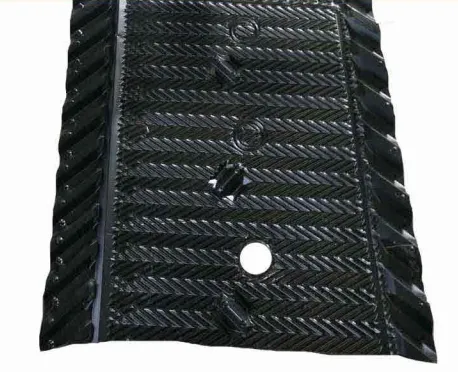
Every fill datasheet lists sheet thickness, and almost every buyer treats it as a footnote. It should be the other way round. Moving from 0.35 mm to 0.45 mm roughly doubles module stiffness, adds about 29% to pack weight, and shifts delivered cost per cubic metre by 20–35%. None of it appears in a quotation unless you ask, and it cannot be inspected once the pack is running at 40 °C.
1. What 0.35 mm really means
Thickness is set on the forming line and partly lost when flat PVC is thermoformed into a flute. The crest thins while the flat land stays close to nominal, and on a typical cross-fluted profile the crest can end up 8–12% thinner — so a “0.35 mm” sheet may measure 0.31 mm exactly where cleaning and wear concentrate. Quote thickness as nominal plus a tolerance of ±0.02 mm, and name the measurement location: flat land and flute crest. A datasheet with no tolerance is a marketing number.
2. Stiffness follows the cube of thickness
Bending stiffness rises with the third power of thickness. Going from 0.35 mm to 0.45 mm gives (0.45/0.35)³, about 2.1 — more than double the resistance to sag. Span matters more: deflection scales with the fourth power, so doubling a grid pitch from 610 mm to 1,220 mm multiplies it by 16.
- 610–810 mm modules: 0.35–0.40 mm where water is clean and the grid is sound.
- 1,000–1,220 mm modules: 0.40–0.45 mm, or 0.35 mm only with an intermediate support.
- 1,520 mm industrial packs: 0.45 mm minimum — and check the grid load rating, not just the sheet.
The heavy-duty range in our CF series large-scale industrial fill is built for that third case: 1,000–1,520 mm heights in a glue-free assembly that holds flute alignment without glue lines acting as stiffeners.
3. Thermal performance barely notices
Area is geometry, not gauge. A 16 mm flute pattern gives roughly 160 m²/m³; a 20 mm pattern about 140 m²/m³. Change 0.35 mm to 0.45 mm on the same pattern and the wetted area is effectively unchanged — the airflow penalty is usually under 3% extra pressure drop, and is offset by better shape retention.
The real effect is indirect. A sagging thin pack closes its flute channels and can shed 10–15% of effective contact area long before it breaks. If a tower is short on approach and the fill is eight years old, measure the flute gap before blaming the fan.
For clean-water HVAC and data centre duty at 610–810 mm modules, 0.35 mm in a well-supported cross-fluted CF pack is a cost-efficient choice — provided the PVC is UV-stabilised and rated to 55 °C continuous.
4. When the extra 0.10 mm pays for itself
Thickness is cheapest at the factory and most expensive in the tower. Three situations justify 0.45 mm:
- Dirty water. Above roughly 50 mg/L suspended solids, cleaning becomes frequent, and cleaning is what destroys thin fill: 40 bar washing at close range deforms a 0.35 mm flute permanently.
- Long service intervals. Outage-driven plants that open a tower every five years need the pack to hold shape for five years, not two.
- High UV load. Un-stabilised PVC embrittles in three to five seasons on high-sunlight sites; thicker sheet retains more residual section when it does.
| Sheet (mm / micron) | Typical span | Relative pack mass | Indicative FOB price | Best fit |
|---|---|---|---|---|
| 0.35 / 350 | up to 810 mm | 100 | USD 95–115 per m³ | Clean water, HVAC, data centre |
| 0.40 / 400 | 810–1,000 mm | 114 | USD 110–130 per m³ | General industrial retrofit |
| 0.45 / 450 | 1,000–1,520 mm | 129 | USD 125–150 per m³ | Dirty water, process, heavy duty |
Treat those bands as a sanity check, not a quote. The ratio is the durable part: 0.35 mm to 0.45 mm is roughly 25–30% more material cost and similar extra weight, which brings freight into the decision.
Counterflow duty tilts the answer further. Vertical packs in a VF series counterflow fill carry water down the flutes, foul faster at the same water quality and are harder to inspect. Between 0.35 mm and 0.45 mm in a counterflow tower, take the thicker sheet and spend the difference on inlet filtration.
5. What to put in the specification
Four lines end most of the argument: nominal thickness with tolerance; where it is measured; the support grid pitch the pack is designed for; and the maximum continuous water temperature. Add UV stabilisation and a declared fire rating, and the sheet you receive matches the sheet you priced.
Send us your tower model, fill module dimensions, grid pitch and a water analysis, and our engineering team will return a written recommendation with the thickness, flute pattern and surface area per cubic metre stated explicitly — so the next quotation you compare is a like-for-like one.