Technical Guide
How to Choose Cooling Tower Fill: Crossflow vs Counterflow, Flute Spacing and Material
2026-11-02 · Engineering
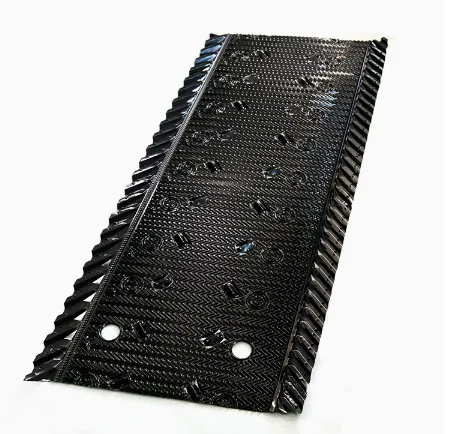
Fill media is not a consumable you buy by the sheet metre. It is the component that decides whether a cooling tower reaches its design approach temperature — typically 60–70% of the thermal performance of a crossflow or counterflow tower comes down to what happens inside the fill pack. Get the specification wrong and you pay for it twice: once at purchase, and again every summer when the tower cannot hold its set point.
This guide covers the five variables that actually matter when selecting fill, and the six questions worth asking any supplier before you place an order.
1. Start with flow type, not price
Crossflow and counterflow towers need different fill because the air and water meet at different angles. Using the wrong one is the most common specification error we see in retrofit projects.
| Property | Crossflow fill (e.g. CF series) | Counterflow fill (e.g. VF series) |
|---|---|---|
| Air/water contact | Perpendicular, across the falling film | Opposed, vertically through the pack |
| Typical flute angle | 15–30° cross-fluted | 45–60° or vertical offset patterns |
| Fouling tolerance | Higher — easier to inspect and flush | Lower — needs cleaner water |
| Footprint | Larger | Smaller for the same duty |
| Best fit | Retrofits, dirty water, HVAC | New towers, tight plots, process cooling |
If you are replacing media in an existing tower, match the original flow type first. A counterflow pack dropped into a crossflow tower will short-circuit air and lose 15–25% of its capacity.
2. Flute spacing decides the trade-off
Surface area is quoted in m²/m³ and it is the number that drives heat transfer — but it is not free. Tighter spacing means more surface and better thermal performance, and also more risk of plugging when the water carries scale, silt or biological growth.
- 16 mm — around 160 m²/m³. Maximum thermal efficiency, only for clean, filtered water.
- 19 mm — a general-purpose compromise for most cooling tower and HVAC duty.
- 20 mm — around 140 m²/m³. Recommended for industrial water with suspended solids, or where cleaning access is limited.
A useful rule: if your water source is a river, a cooling pond or a site with visible algae, go up one flute size rather than spending the difference on cleaning labour every quarter.
3. PVC or PP: temperature and water chemistry
Both materials work. The choice is driven by operating temperature and the chemical treatment programme.
- PVC — the default. Rated to roughly 55 °C continuous, excellent chemical resistance, self-extinguishing grades available. Best value for HVAC, data centre and general industrial duty.
- PP — for higher temperatures (up to about 70 °C) and for aggressive chemistries. Also the better choice where UV exposure is extreme and the fill will run for 20+ years without replacement.
Two specification details are worth insisting on: UV stabilisation (un-stabilised PVC embrittles within a few seasons in high-sunlight sites) and a documented fire rating. Both add a small percentage to unit cost and a large percentage to service life.
4. Height and module size
Deeper packs give more contact time but raise air-side pressure drop, which the fan then has to pay for. Standard crossflow modules run 610 mm, 750 mm, 810 mm, 950 mm and 1,300 mm; industrial counterflow packs often go to 1,500 mm and beyond.
Match the module to the existing support grid where you can. Cutting fill on site is possible but leaves open edges that channel air and reduce performance.
5. Six questions before you order
- What is the tower model and flow type? Crossflow or counterflow decides the entire specification.
- What is the circulating water quality? Suspended solids, hardness and biological load determine flute spacing.
- What is the maximum water temperature? Above 55 °C, PVC is out.
- What module height fits the support grid? Avoid site cutting.
- Is the material UV stabilised, and what is the fire rating? Ask for the data sheet, not the brochure.
- What is the documented surface area per m³? Compare like for like — some suppliers quote nominal flute size instead.
What this means in practice
Most fill failures we are called out to are not material failures. They are specification mismatches: a 16 mm pack in water that needed 20 mm, PVC in a 60 °C process loop, or a counterflow pattern in a crossflow tower. A fifteen-minute specification review at the quotation stage avoids all three.
If you are unsure which series fits your tower, send us the tower model, the fill module dimensions and a water analysis — our engineering team will come back with a written recommendation and a like-for-like surface area comparison.