Technical Guide
Marley MX crossflow fill replacement: field sizing guide
2026-11-10 · Engineering
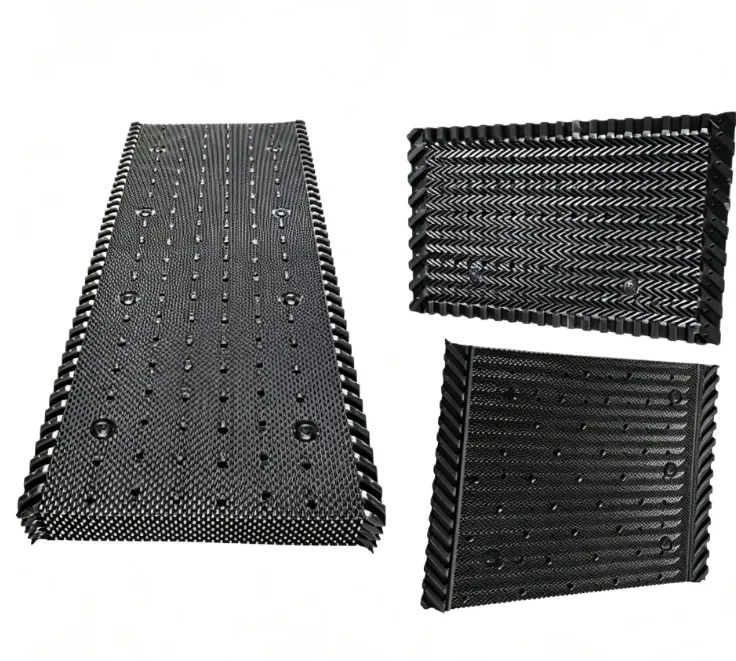
The Marley MX is a factory-assembled crossflow tower: two air inlets, hot water spread from a basin above the pack, air crossing horizontally through the fill before the fan lifts it out. Units from the 1990s still sit on HVAC decks, and the structure usually outlasts the fill by a decade. What fails first is the pack: flutes flatten under load, scale bridges the sheet gaps, approach temperature creeps up a few tenths of a degree a season. Replacing it is a contained job, but only after the bay has been measured — MX cells of similar footprint do not share fill geometry.
1. Depth first, then four numbers
Fill sits between the louver face and the drift eliminator plane, and the distance air travels through it is the number that picks the module. We still see MX retrofits ordered at 1220 mm because “crossflow towers are 1220 deep”, then trimmed to fit a 915 mm bay. Cutting is not neutral: flutes lose continuity at the cut face, the block loses edge support, and the bay gives up 3–8% of wetted surface. A 610 mm pack in a 915 mm bay is wrong in the other direction, throwing away 0.4–0.8 °C of approach at design wet-bulb unless the fan is re-checked.
Four measurements set the module schedule:
- Air-path depth. 610, 915 or 1220 mm covers most MX bays. Measure louver frame to eliminator plane, not the tray lip — the lip adds 25–40 mm the module cannot use.
- Usable face height. Basin curb to the underside of the distribution header, minus 100–150 mm for spray clearance.
- Module length. The horizontal run, usually a multiple of 300 mm: 1220, 1520, 1830 or 2440 mm.
- Support rails. 600–1220 mm pitch is normal at 0.45 mm sheet. Photograph section and corrosion before the old pack comes out.
Face height ÷ module height gives rows, length ÷ module length gives blocks per row, plus a cut filler strip per row.
2. Flute spacing, weight and price
The trade is surface area against pressure drop, sheet thickness against weight. 2026 FOB ranges for glue-free crossflow blocks:
| Pack | Surface area | Dry density | Depth / height | Price per m³ |
|---|---|---|---|---|
| 20 mm flute, 0.45 mm sheet | 150–170 m²/m³ | 110–135 kg/m³ | 610 / 810 mm | USD 105–150 |
| 19 mm flute, 0.35 mm sheet | 165–185 m²/m³ | 95–115 kg/m³ | 610 / 750 mm | USD 100–145 |
| 16 mm flute, 0.45 mm sheet | 190–220 m²/m³ | 115–140 kg/m³ | 610 / 810 mm | +5–12% |
| Heavy-duty module | 150–180 m²/m³ | 110–135 kg/m³ | 1220 / 1520 mm high | USD 95–135 |
Two cautions. A 16 mm pack raises static pressure 15–25% at equal face velocity, so take it only where the fan has headroom. Wet weight runs 10–14% above dry — that is what the rails carry, not the shipping weight.
3. Access decides the method
MX cells are entered through the louver openings, typically 900–1200 mm wide. A 1525 × 1830 × 810 mm glue-free block weighs about 110 kg and two people can hand it in without a crane; a 2440 mm block of the same sheet needs rigging and a longer window. This is where a mechanically assembled block earns its keep: it goes in flat and locks up inside the bay, often the only way to work without pulling the fan stack. Budget a bay a day with two hands, both bays with four.
For shallow bays, glue-free cross-fluted modules in 610 and 810 mm depths drop into most retained rails. Where OEM geometry is uncertain, the CF915-MA universal replacement pack is built to a 915 mm air path and covers the common factory-assembled footprints. Where duty has been uprated since installation, a 16 mm precision flute pack recovers surface area without changing depth.
4. What to check in the first week
Spray coverage: walk the top of the pack for dry patches, which cost more approach than a marginal flute choice. Drift: clean and re-seat the eliminator while the bay is open, a fifteen-minute job at that point. Baseline: log wet-bulb, hot water and cold water for a week at steady load. A tower that lost 0.3–0.6 °C of approach to fouled pack usually returns most of it, but not on day one — new pack wets out over 24–48 hours.
Conclusion
Replacing fill in a Marley MX tower is not a search for an OEM part number. Measure air-path depth and usable face height, check the support rails, and let those facts choose depth, flute spacing and block size. A bay that takes a 915 mm glue-free module should have one; a bay built around a 610 mm tray should not be forced into 1220 mm and cut to fit.
Send the four measurements, the support pitch and two seasons of approach readings, and our engineers will return a module schedule — rows, block count, weight per block and cost per m³ — stated line by line.