Technical Guide
Replacing cooling tower fill without a production shutdown
2026-11-11 · Engineering
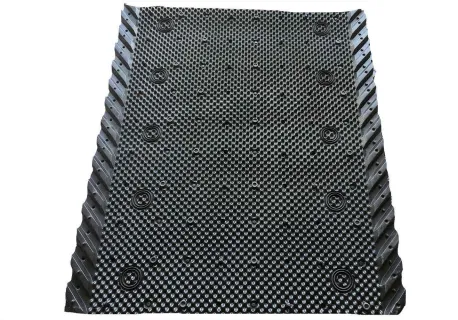
Most fill replacements are planned as a plant shutdown: drain the basin, isolate the tower, work for a week, restart. For a mill or data hall running three shifts, that week often costs more than the fill. A multi-cell tower runs on reduced capacity, and fill can be changed one cell at a time with the plant online — if the sequencing is settled before the first module comes out.
1. What the plant must supply with one cell open
Before anyone measures a bay, confirm three things. Basins are cross-connected by an equalising pipe of at least 150 mm, so the tower can be walked down to a low level in one cell without starving the pumps. Each cell has an isolatable riser and a valve that actually closes — a passing valve is the most common reason a “no-shutdown” job becomes a shutdown. And the plant carries 15–25% thermal margin at the worst hour of the week.
If it is already at the edge of capacity at design wet-bulb, no sequencing plan will save it. Say so at quotation stage, not in week one.
A two-cell tower with one cell out is a single-cell tower; cold water drifts 0.5–1.5 °C depending on wet-bulb and wind. That is survivable because it arrives slowly — a condenser seeing 1 °C warmer water loses roughly 3–5% of chiller efficiency, a cost, not a trip. The limits to write into the method statement:
- Hot water temperature. Keep inlet below 45 °C during the swap. Above that, a PVC pack is being pushed exactly when it has no redundancy.
- Wet-bulb window. Demolish in the season with the lowest design wet-bulb; 2 °C there buys more margin than any temporary fan work.
- Alarms. Raise the high-temperature setpoint temporarily and tell the control room why, in writing.
- Single failure. Never open both cells of a two-cell tower on the same day.
2. Module size decides the crane question
A 1525 × 1830 × 810 mm glue-free block of 0.45 mm sheet weighs about 110 kg; two people can hand it through a 900–1200 mm louver opening. A 2440 mm block runs 190–240 kg, which means rigging, a crane and a permit window that may only exist at weekends.
| Block format | Dry weight | Handling | Time per bay |
|---|---|---|---|
| 610 × 1220 × 1525 mm | 55–70 kg | Two persons, through the louver | 0.5 day |
| 810 × 1525 × 1830 mm | 100–125 kg | Two persons in the bay | 1 day |
| 915 × 1830 × 1830 mm | 130–160 kg | Trolley, three persons | 1–1.5 days |
| 1220 × 1830 × 2440 mm | 190–240 kg | Crane or hoist, permit | 2–3 days |
For shallow bays, glue-free modules in 610 and 810 mm depths assemble flat and lock up inside the bay, with no adhesive cure time — a glued pack wants 24 hours of clean, dry air before loading, a day a live plant does not have. In 750 mm bays the CF750-LC retrofit pack drops into retained rails without cutting. Where duty has grown since installation, heavy-duty modules in 1000–1520 mm heights cut the pieces per bay, at the cost of that crane window.
3. Water, dust and the working cell
Sheet dust is the fastest way to clog the nozzles of the cell still in service. Sheet the open bay on the working side, cut outside the tower, flush nozzle strainers every shift. Lower the basin to the minimum the pumps tolerate, then drain the isolated cell into the working basin rather than to drain — 30–40 m³ of treated water per cell is normal, and returning it keeps cycles of concentration stable. Stage modules within 50 m of the louver, load bottom row first, and expect 24–48 hours of wet-out before the new pack reaches rated approach.
4. A sequence that holds up
Measure both bays at week minus two and order modules with the fastener kit. Week one: strip and rebuild cell A — half a day of pre-checks, one to three days of work — then run it alone for 48 hours before touching cell B. If cell A returns within 0.2 °C of design approach, the schedule is right and cell B is a repeat; if not, the error is found on one cell instead of two.
Conclusion
Staying online through a fill replacement is not a scheduling trick. It follows from enough plant margin, isolatable cells, a block light enough to handle by hand, and a sequence that proves the first cell before the second opens. Done that way, 2026 pricing of USD 95–150 per m³ for glue-free pack buys days of work rather than an outage.
Send the cell count, basin connection size, bay depth and worst-case wet-bulb, and we will return a cell-by-cell sequence with block weights, crew hours and the water volume to recover.